HP ProDesk Price Error: $2,153 Bundle for $144
An HP ProDesk price error dropped a $2,153 mini PC and monitor bundle to $144. See the alert, member orders, delivery proof, and resale potential.
 By The Lab Team
In this guide
- 01The alert: a $2,153 HP bundle at $144
- 02One bundle made it through checkout
- 03One member scaled the order to nine bundles
- 04The nine-bundle order touched down
- 05Why this error created resale potential
- 06How to calculate the real margin
- 07Fast alerts created the opportunity
- 08A buy/pass checklist for the next price error
An HP ProDesk price error turned a desktop-and-monitor bundle with $2,153 in displayed component MSRP into a $144 checkout on July 10, 2026. The Lab's HP monitor sent members the product, price gap, and research links while the bundle was still orderable. One member then scaled the opportunity to nine bundles, and five days later that order reached their door.
The screenshot shows $2,009 in displayed savings per bundle, not resale profit. Profit starts with the acquisition cost and ends after sold comps, fees, shipping, returns, and the chosen exit are accounted for.
The alert: a $2,153 HP bundle at $144
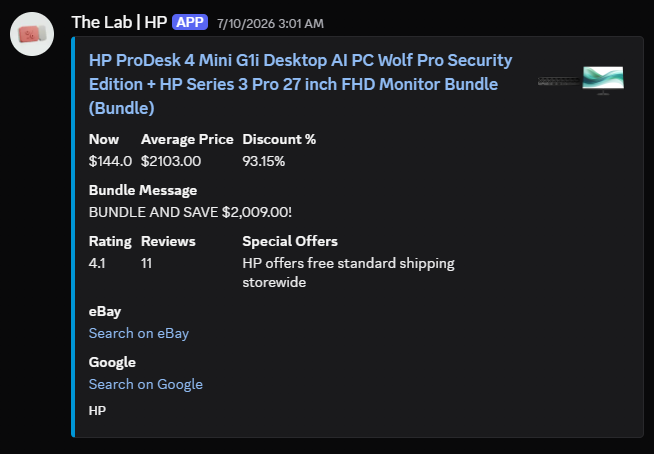
The Lab's monitor posted the alert at 3:01 AM on July 10. It identified an HP ProDesk 4 Mini G1i Desktop AI PC Wolf Pro Security Edition bundled with an HP Series 3 Pro 27-inch FHD monitor.
| Signal | What the alert showed |
|---|---|
| Bundle | HP ProDesk 4 Mini G1i desktop plus HP Series 3 Pro 27-inch FHD monitor |
| Alert price | $144 |
| Average price in the monitor | $2,103 |
| Component MSRP on the later order page | $2,153 |
| Displayed discount | 93.15% |
| Displayed bundle savings | $2,009 |
| Research shortcuts | eBay and Google searches |
The average price and component MSRP are different figures from different screens. The monitor showed a $2,103 average, while the HP order page later listed $194 for the monitor and $1,959 for the desktop, totaling $2,153.
The alert also included eBay and Google shortcuts. That matters because a reseller does not need another message saying a price looks low. They need enough context to check the exact product and its exits before checkout closes. If you are new to the mechanism, start with what a price error is and why it happens.
One bundle made it through checkout
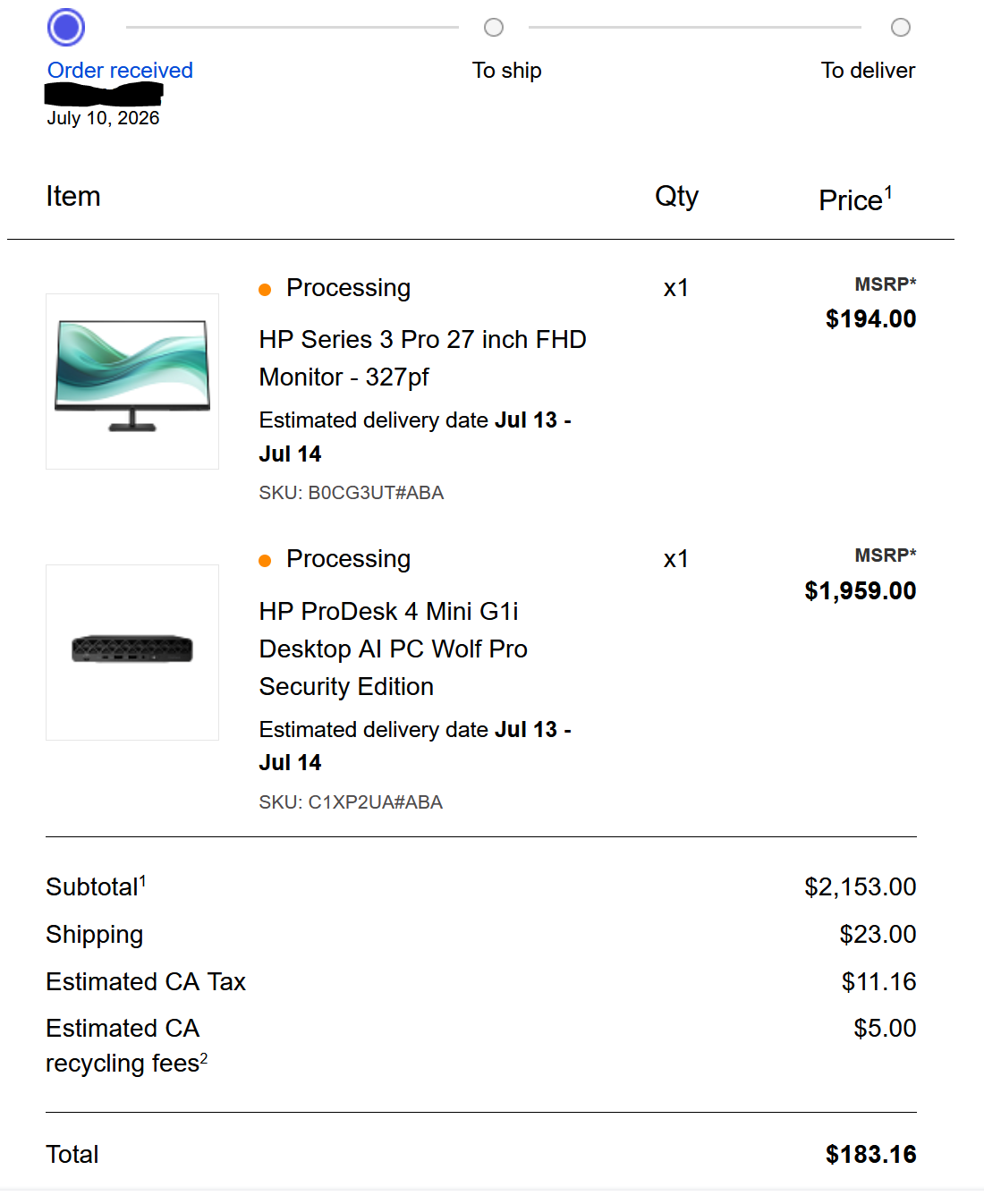
The first order screenshot confirms that the bundle could be placed as one desktop and one monitor. It also shows why the advertised price and the all-in cost should never be treated as the same number.
| Order line | Amount |
|---|---|
| Bundle price | $144.00 |
| Shipping | $23.00 |
| Estimated tax | $11.16 |
| California recycling fee | $5.00 |
| Final total | $183.16 |
The order page displayed the two components at $2,153 in combined MSRP, then showed a $183.16 final total after the bundle pricing and order-specific charges. The extra $39.16 came from shipping, estimated tax, and the recycling fee. Another buyer's total could differ by state, tax treatment, shipping promotion, or local fees.
An order confirmation is progress, not certainty. HP's terms and conditions say correct prices and promotions are validated when an order is placed and that HP may cancel orders arising from pricing or other errors. Until fulfillment advances, a reseller still has a pending opportunity rather than inventory.
One member scaled the order to nine bundles
The next screenshot shows what happened when one member increased quantity. The order subtotal was $1,296. At $144 per bundle, that is exactly nine bundles.
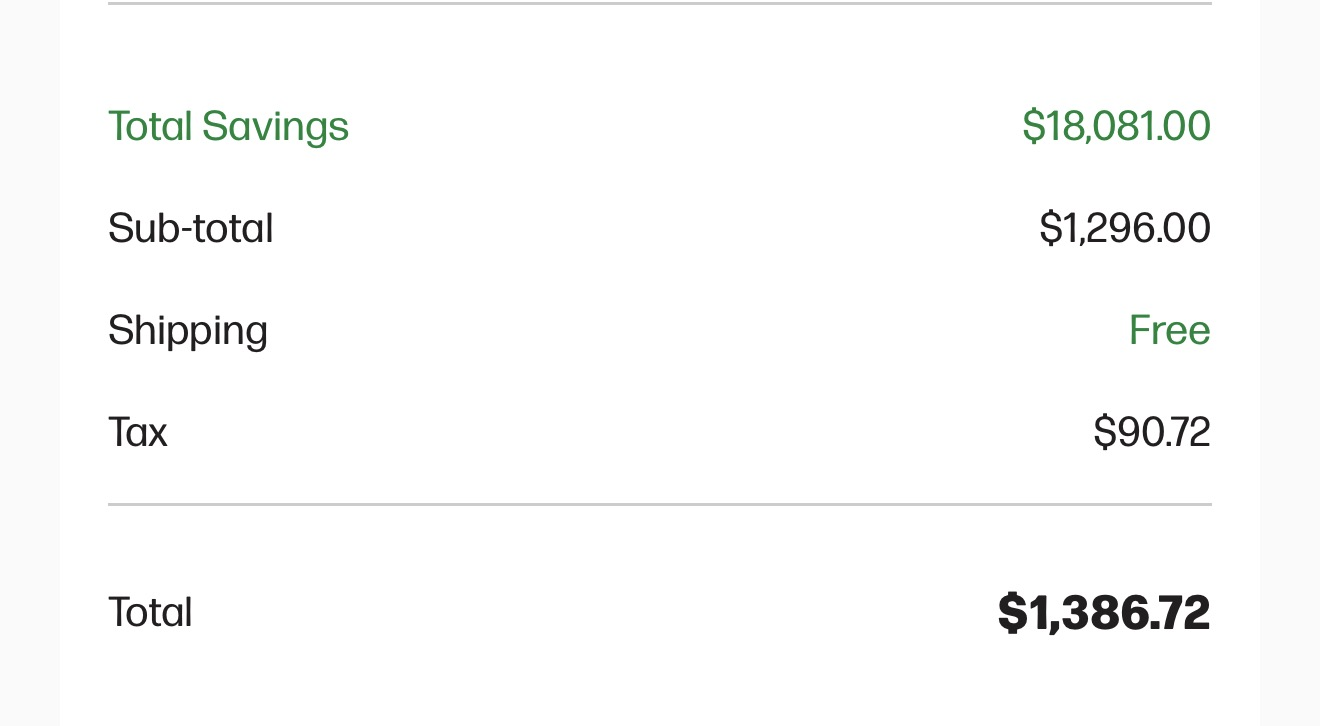
| Nine-bundle order | Amount |
|---|---|
| Quantity | 9 bundles |
| Subtotal | $1,296.00 |
| Shipping | Free |
| Tax | $90.72 |
| Final total | $1,386.72 |
| Displayed savings | $18,081.00 |
| Average all-in cost per bundle | $154.08 |
Nine times HP's displayed $2,009 bundle savings equals $18,081, confirming the same pricing across nine units. It remains a retail savings display, not an earnings statement.
The number a reseller should carry forward is the $154.08 average all-in cost per bundle: the $1,386.72 final total divided by nine.
Quantity increases the possible upside, but it also multiplies capital at risk, storage needs, listing work, monitor-shipping exposure, and the time required to sell through. A large spread is a reason to investigate quantity, not permission to ignore demand.
The nine-bundle order touched down
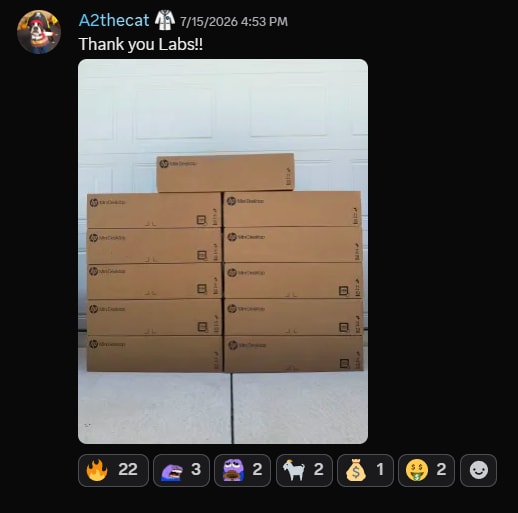
On July 15, the same member posted a stack of HP boxes and thanked The Lab. That connected the nine-bundle checkout to delivered inventory five days after the alert.
| Date | Evidence |
|---|---|
| July 10, 2026 | Monitor alert and HP order received |
| July 15, 2026 | Member posted the delivered HP boxes |
Delivery changes the case study. A low-price screenshot can disappear and a processing order can be corrected. Delivered boxes are inventory the buyer can inspect and list.
The delivery photo does not prove a completed resale, and it should not be used that way. What it proves is that this member's nine-bundle order survived the pricing-error window and became physical stock with an average all-in acquisition cost of $154.08 per bundle.
Why this error created resale potential
The clearest path to profit was not the $2,153 MSRP headline by itself. MSRP can sit well above the price buyers actually pay. The opportunity came from combining a very low cost basis with products that have understandable use cases and more than one possible exit.
| Exit route | Why it could fit | What to verify first |
|---|---|---|
| Desktop and monitor together | Simple ready-to-use office or home setup | Local bundle demand and the exact PC configuration |
| Desktop sold separately | Compact business PCs are easier to store and ship than towers | CPU, RAM, storage, warranty, sold comps, and marketplace eligibility |
| Monitor sold separately | A 27-inch FHD display has a broad local buyer pool | Local pricing, panel condition, included stand and cables |
| Mixed local and online exits | Keeps bulky monitors local while giving the mini PCs wider reach | Time cost, fees, packaging, and sell-through speed |
The compact desktop is easier to handle than a tower. The monitor has broad utility, but its size adds shipping cost and damage exposure. Separate sales may increase proceeds; a complete setup may reduce labor. Configuration and local demand decide.
At $144 before charges, the order had room to sell far below displayed MSRP and still create a credible margin. That is the reseller appeal. The low cost basis gives the seller options. It does not remove the need to validate the market.
How to calculate the real margin
For the nine-bundle order, $154.08 is the average acquisition cost per bundle. It is not the online break-even point. A useful calculation is:
Expected net = sale proceeds - marketplace fees - payment fees - outbound shipping - packaging - return allowance - allocated acquisition cost
Run that calculation against the exact unit you plan to list:
- Confirm the ProDesk's CPU, RAM, storage, operating system, accessories, and warranty status.
- Check recent sold comps for that configuration or the nearest honest comparison.
- Price the desktop and monitor as a bundle, then price them separately.
- Add marketplace and payment fees for each route.
- Quote shipping with the real packed dimensions, especially for the monitor.
- Reserve room for returns, damage, missing accessories, and buyer negotiation.
- Compare the resulting net with a faster local-cash exit.
If the desktop and monitor are split, allocate the $154.08 cost basis between them before measuring profit. Otherwise both listings can appear more profitable than the combined order really was.
This is where sold comps protect the buyer from the MSRP trap. The HP page explains the discount. The market decides the exit.
Fast alerts created the opportunity
The value of this case was not seeing a screenshot after the price had been fixed. The Lab's monitor supplied the exact bundle, current price, average price, discount, displayed savings, and research shortcuts while members could still reach checkout.
That is the workflow behind effective price error alerts: detect the outlier, compress verification, place the order, then use community status updates to learn whether confirmations are moving, canceling, shipping, or landing. In this case, the feedback loop progressed from a one-bundle order to a nine-bundle order and then to delivery proof.
The useful version of “early” is not an unsupported claim that nobody else saw the listing. It is evidence that the alert arrived with enough time for members to act. If you want that workflow before the next listing is corrected, join The Lab for monitored price-error alerts and member order updates.
A buy/pass checklist for the next price error
Use the HP order as a model, not a guarantee:
- Verify the exact SKU and configuration before scaling quantity.
- Compare the alert price with sold comps, not only MSRP or asking prices.
- Separate displayed savings from expected net profit.
- Include tax, shipping, fees, packaging, returns, and damage risk.
- Check whether the product has more than one credible exit channel.
- Treat cancellation as possible until the order reaches a meaningful fulfillment stage.
- Scale only when capital, storage, and demand can support the quantity.
- Use community order updates to revise expectations as the retailer responds.
The HP ProDesk price error had the ingredients resellers look for: a severe pricing gap, useful hardware, fast alerting, successful checkout, quantity, and confirmed delivery. The alert created the opening. Careful cost accounting is what turns that opening into a real resale plan.